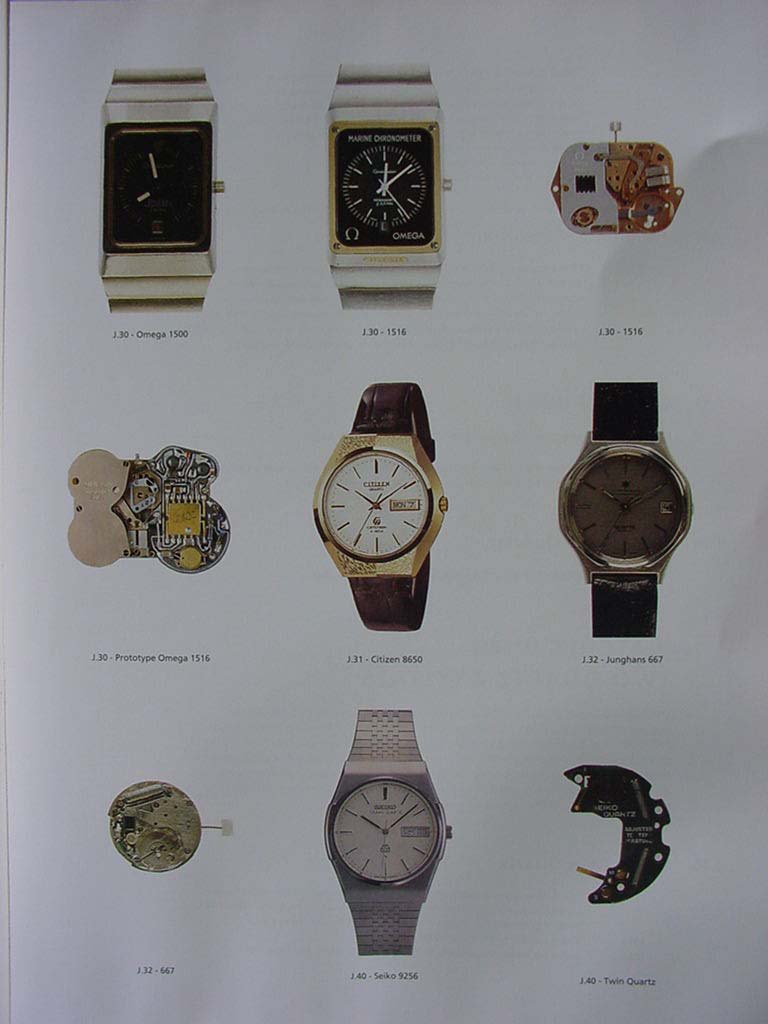
The auxiliary crystal oscillator detects the temperature and in conjunction with the micro-processor in the watch, compensates the timing error of the main crystal oscillator. This method of temperature compensation can jerk up the watch accuracy from the order of a monthly rate of five seconds to the order of the same yearly rate. The production of these watches was expensive, and as the general public didn't need such an extreme accuracy, the production stopped after a few years. Since 1972, inhibition technology became known, at the time a new technique but still used today.
| 1978 | The first watch equipped with two quartz crystals was the Seiko Twin Quartz caliber 9256. Other calibers are 9923, 9940, 9942, 9943, 9980, 9983, 9920, 9921 and 9923. Maximum deviation of five seconds a year. |
| 1979 | Seiko cal. 9721, 9722 and 9723. |
| 1980 | Seiko cal. 9641, 9642, 9681, 9441, 9442, 9443, 9481, 9483 and 9461. |